- Pag-IBIG Contribution Table 2026
- How to Compute Your Pag-IBIG Contribution Table 2026
- Self-Employed, Voluntary, and OFW Members
- Contributing More Than the Mandatory Amount
- Remittance Deadlines
- Using Your National ID for Pag-IBIG Transactions
- Frequently Asked Questions About Pag-IBIG Contribution Table 2026
Pag-IBIG contribution table 2026 hasn’t changed from the rates set in early 2024 — but it’s still one of the most searched payroll questions in the Philippines, because the math looks different depending on how much you earn. This complete guide breaks down the current HDMF contribution rate, the salary ceiling that caps it, and exactly how to compute your own monthly share.
Pag-IBIG Contribution Table 2026
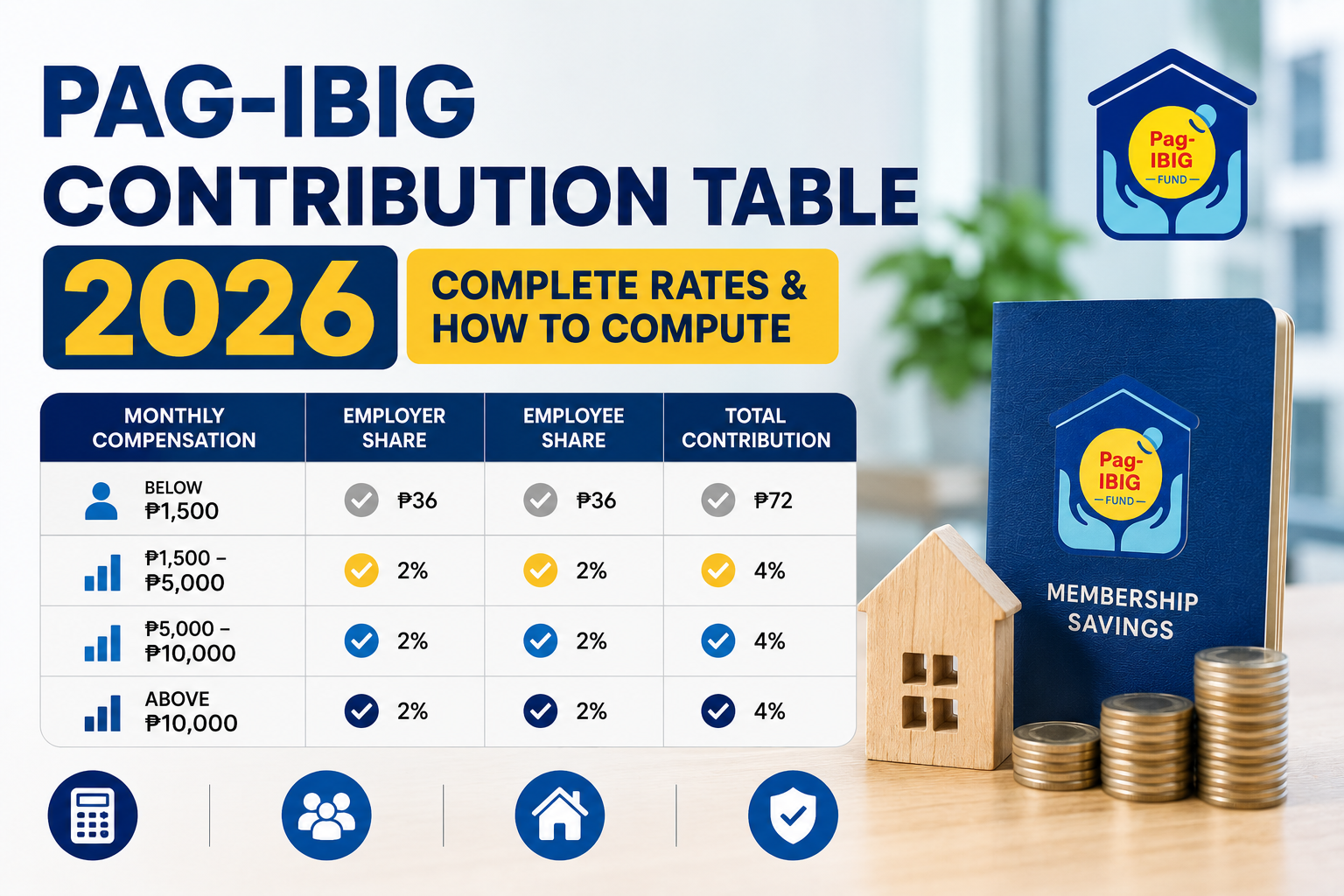
| Monthly Compensation | Employee Share | Employer Share | Total Monthly Contribution |
|---|---|---|---|
| ₱1,500 and below | 1% | 2% | 3% of salary |
| Above ₱1,500, up to ₱10,000 | 2% | 2% | 4% of salary |
| ₱10,000 and above (capped) | ₱200 (fixed) | ₱200 (fixed) | ₱400 (fixed) |
These rates are set under HDMF Circular No. 460, which raised the Maximum Fund Salary from ₱5,000 to ₱10,000 effective February 2024 and remains the current schedule for 2026. No further rate increase has been announced. For official confirmation, check the Pag-IBIG Fund (HDMF) official website.
How to Compute Your Pag-IBIG Contribution Table 2026
The formula is simple once you know the cap:
Contribution = (Monthly Salary, capped at ₱10,000) × Rate (1% or 2%)
Your salary is never used directly above ₱10,000 — the computation simply stops at the ceiling. Three worked examples:
- ₱9,000 monthly salary: Below the ₱10,000 cap, so the actual salary is used. ₱9,000 × 2% = ₱180 employee share, ₱180 employer share.
- ₱25,000 monthly salary: Above the cap, so the computation uses ₱10,000, not ₱25,000. ₱10,000 × 2% = ₱200 employee share, ₱200 employer share — not ₱500 as a direct 2% of ₱25,000 would suggest.
- ₱1,200 monthly salary: Below the ₱1,500 lower bracket. Employee pays 1% (₱12), employer still pays 2% (₱24).
In short: once your salary hits ₱10,000, your Pag-IBIG deduction stops increasing — a ₱15,000 earner and a ₱150,000 earner pay the exact same ₱200 mandatory share.
Self-Employed, Voluntary, and OFW Members
If you don’t have an employer to split the contribution with, you pay both shares yourself — 4% of your declared monthly income (or 3% if it’s ₱1,500 or below), still capped at the ₱10,000 MFS ceiling. That works out to a maximum of ₱400/month, same as the combined employee + employer total for a regular employee.
Contributing More Than the Mandatory Amount
The ₱200 cap is only the mandatory minimum. Members can voluntarily contribute more — up to ₱5,000/month — through the regular savings program, or through Modified Pag-IBIG II (MP2), a separate five-year voluntary savings option that historically pays a higher dividend rate than the regular fund. Employer matching is not required on voluntary amounts above the mandatory ceiling.
Remittance Deadlines
Employers must remit both shares on or before the 10th day of the month following the applicable payroll period. Late remittance incurs a penalty for each day of delay, so if your contribution isn’t reflecting on your record within a few weeks after payday, a short posting lag is normal — but a gap of more than a month or two is worth raising directly with your employer or HR.
Using Your National ID for Pag-IBIG Transactions
Your PhilID is accepted as a valid ID for most Pag-IBIG member transactions, including loan applications and in-branch verification — but as with SSS, any mismatch between your National ID details and your Pag-IBIG membership record (a maiden name still on file, a mistyped middle name, etc.) can cause delays at verification. See our full breakdown of using your National ID for Pag-IBIG transactions for how to check and correct this before it holds up a loan or withdrawal.
If you’re also tracking your SSS contributions, our companion guide on how to check SSS contribution online covers the same kind of record-matching issue for that agency.
Frequently Asked Questions About Pag-IBIG Contribution Table 2026
Q: What is the Pag-IBIG contribution rate for 2026? A: 2% of monthly compensation for both employee and employer (1% for the employee if salary is ₱1,500 or below), computed on a salary capped at ₱10,000.
Q: What is the maximum Pag-IBIG contribution in 2026? A: ₱200 from the employee and ₱200 from the employer, for a combined ₱400/month — reached by anyone earning ₱10,000 or more.
Q: Why is my Pag-IBIG deduction ₱200 even though I earn ₱30,000? A: Contributions are computed on your salary only up to the ₱10,000 Maximum Fund Salary ceiling — anything above that isn’t factored in for the mandatory contribution.
Q: Can I contribute more than ₱200 a month? A: Yes, voluntarily — either through additional regular savings (up to ₱5,000/month) or through MP2, a separate five-year voluntary savings program.
Q: How do self-employed or voluntary members pay Pag-IBIG? A: They pay both the employee and employer shares themselves — 4% of declared income (3% if ₱1,500 or below), still capped at ₱10,000, for a maximum of ₱400/month.