- What Is a Barangay ID?
- Barangay ID Requirements Philippines 2026: Core Documents
- Barangay ID Fees Philippines 2026
- How to Apply for a Barangay ID Philippines 2026
- Barangay ID Processing Time Philippines 2026
- Barangay ID vs. National ID: Which Should You Use?
- Frequently Asked Questions About Barangay ID Requirements Philippines 2026
Barangay ID requirements Philippines 2026 are simple — bring one valid government-issued ID, proof of residency in the barangay, and a small processing fee (typically ₱20–₱150). Most applications are processed the same day, often within 10–60 minutes, making it one of the fastest and cheapest identification documents you can get. This complete guide covers the exact requirements, typical fees, processing time, and where a Barangay ID actually holds up compared to your National ID.
What Is a Barangay ID?
A Barangay ID is a locally issued identification card confirming your residency and identity within a specific barangay. It’s issued by the barangay hall itself, not a national agency — so exact Barangay ID requirements Philippines 2026, materials (PVC card vs. laminated cardboard), and fees vary from one barangay to the next since each barangay sets its own policy by local ordinance.
It’s often confused with two related but distinct documents:
| Document | What It Confirms | Typical Use |
|---|---|---|
| Barangay ID | Your identity and residency, as a physical card | Everyday local ID, secondary ID for KYC purposes |
| Barangay Certificate | Residency and standing in the community, as a document (not a card) | Supporting document for other applications (Postal ID, bank accounts, school) |
| Barangay Clearance | Residency plus “no derogatory record” in the community | Employment, business permits, follow-up for NBI/police clearance |
Some barangays print all three from the same template with different wording, but they aren’t interchangeable — ask specifically for the “Barangay ID” if that’s the physical card you need.
Barangay ID Requirements Philippines 2026: Core Documents
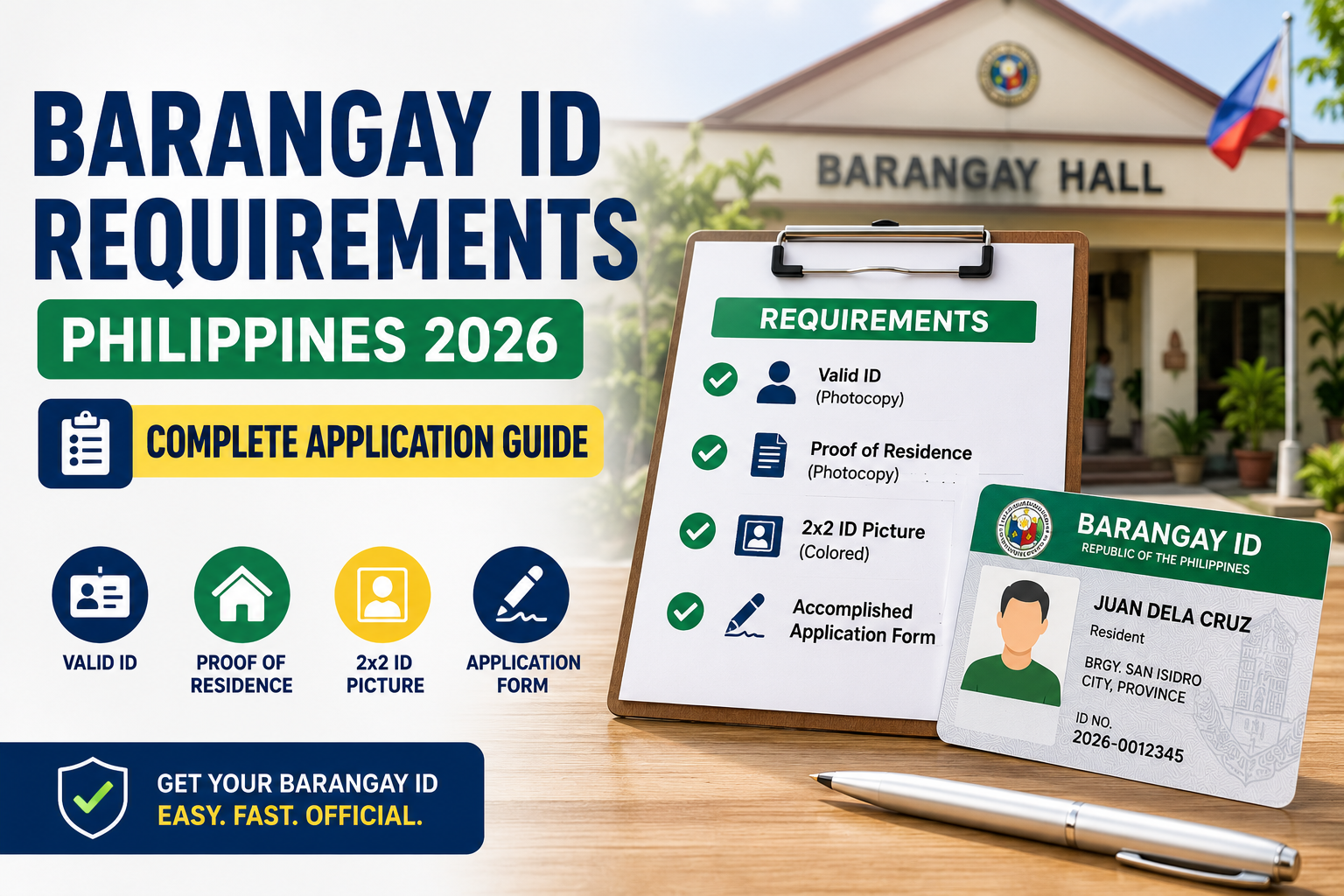
Barangay ID requirements Philippines 2026 vary by barangay, but most offices ask for the same core set:
- One valid government-issued ID — National ID (PhilID), passport, driver’s license, UMID, PhilHealth ID, voter’s ID, or Postal ID are commonly accepted.
- Proof of residency in the barangay — a utility bill, lease contract, or existing barangay record showing your address. If you’ve just moved, expect to provide stronger verification since you won’t yet be in the barangay’s records.
- Accomplished application form — provided at the barangay hall; fill in your details and the ID’s purpose.
- 1–2 recent passport-sized (2×2) photos — required by some barangays if photo capture isn’t available on-site.
- Processing fee — paid at the cashier window, unless you qualify for a fee waiver (see below).
If you don’t have a government-issued ID yet, the barangay may accept a school ID plus stronger residency proof, or ask you to be endorsed by a barangay official or a resident who can vouch for you. Renters without a lease contract in their name commonly face this issue — bring whatever address proof you have (mail addressed to you, an employer certificate, etc.) and ask the barangay what will work.
Requirements for Minors
Some barangays issue IDs to minors, typically requiring a parent or guardian to accompany the applicant or provide written consent, plus the minor’s birth certificate. Policy on this varies significantly by barangay — confirm before making the trip.
Barangay ID Fees Philippines 2026
There’s no single national fee — each barangay sets its own rate by local ordinance. Reported Barangay ID fees Philippines 2026 typically fall between ₱20 and ₱150. Some LGUs provide the Barangay ID free as a basic resident service, or waive the fee for specific groups:
- Indigent residents
- Senior citizens
- Persons with disabilities (PWDs)
- First-time job seekers (under RA 11261, for related barangay documents used to support employment — ask if this extends to the ID itself in your barangay)
Always ask for an official receipt when a fee is collected, and check your barangay’s Facebook page or website beforehand — fees and available fee waivers are set locally and can change.
How to Apply for a Barangay ID Philippines 2026
- Visit your barangay hall and ask specifically for the Barangay ID application (not Certificate or Clearance).
- Fill out the application form with accurate personal details.
- Submit your ID and residency proof for verification by barangay staff.
- Have your photo taken on-site, or submit your own 2×2 photos if required.
- Pay the processing fee at the cashier window and keep your receipt.
- Wait for release — many barangays release same-day. PVC-printed IDs may take 30–60 minutes; laminated cardboard versions are often assembled on the spot.
A handful of cities (Quezon City, Makati, Cebu among them) offer online application through their local Barangay Integrated Management System or city portal, but even then most require at least one personal appearance for verification. For most of the country, in-person application at the barangay hall remains the standard process. For official information on barangay governance, see the Department of the Interior and Local Government (DILG) website.
Barangay ID Processing Time Philippines 2026
Most barangays process a Barangay ID Philippines 2026 application the same day, often within 10 minutes to an hour depending on how busy the office is and whether the card is PVC-printed or laminated on-site. Morning visits tend to move faster, before queues build up.
Barangay ID vs. National ID: Which Should You Use?
This is the question that matters most in practice — and it comes down to primary vs. secondary ID status.
| Barangay ID | National ID (PhilID) | |
|---|---|---|
| Issuing authority | Local barangay (varies by LGU) | PSA / PhilSys (national, standardized) |
| ID classification (BSP KYC rules) | Secondary ID | Primary ID |
| Biometric security | None / minimal | Centralized national biometric record |
| Bank account opening (sole ID) | Usually not accepted alone | Accepted as a standalone primary ID |
| Air travel / boarding | Not accepted as sole valid ID | Accepted |
| Remittance claims (e.g. Palawan Express, Cebuana Lhuillier) | Widely accepted | Accepted |
| Local barangay transactions, community programs | Accepted, often preferred | Accepted |
| Cost and speed to obtain | Cheaper, often same-day | Free, but production and delivery can take weeks to months |
In practice: get a Barangay ID for convenience and local transactions while you wait for your PhilID, or use it as a secondary supporting document alongside your National ID. But don’t expect a Barangay ID to substitute for a primary government ID at a bank, airport, or most formal government transactions — that’s specifically what the National ID is for. See our full list of valid government IDs in the Philippines for where each ID type is actually accepted.
If you’re still waiting on your PhilID and want to check where it’s at, see our National ID tracking guide or our breakdown of what each delivery status means.
Frequently Asked Questions About Barangay ID Requirements Philippines 2026
Q: How much does a Barangay ID cost? A: Typically ₱20–₱150, set by local ordinance and varying by barangay. Some LGUs issue it free, especially for indigents, seniors, and PWDs.
Q: How long does it take to get a Barangay ID? A: Most barangays release it the same day, often within 10 minutes to an hour.
Q: Can I use a Barangay ID to open a bank account? A: Generally not on its own — it’s classified as a secondary ID under BSP’s KYC rules. You’ll typically need a primary ID like your PhilID, passport, or driver’s license as well.
Q: Is a Barangay ID the same as a Barangay Clearance? A: No. The ID is a physical identification card; the Clearance is a document certifying residency and good standing, often required separately for employment or business permits.
Q: Can I apply for a Barangay ID online? A: Some cities (Quezon City, Makati, Cebu) offer online application portals, but most barangays nationwide still require an in-person visit for verification.