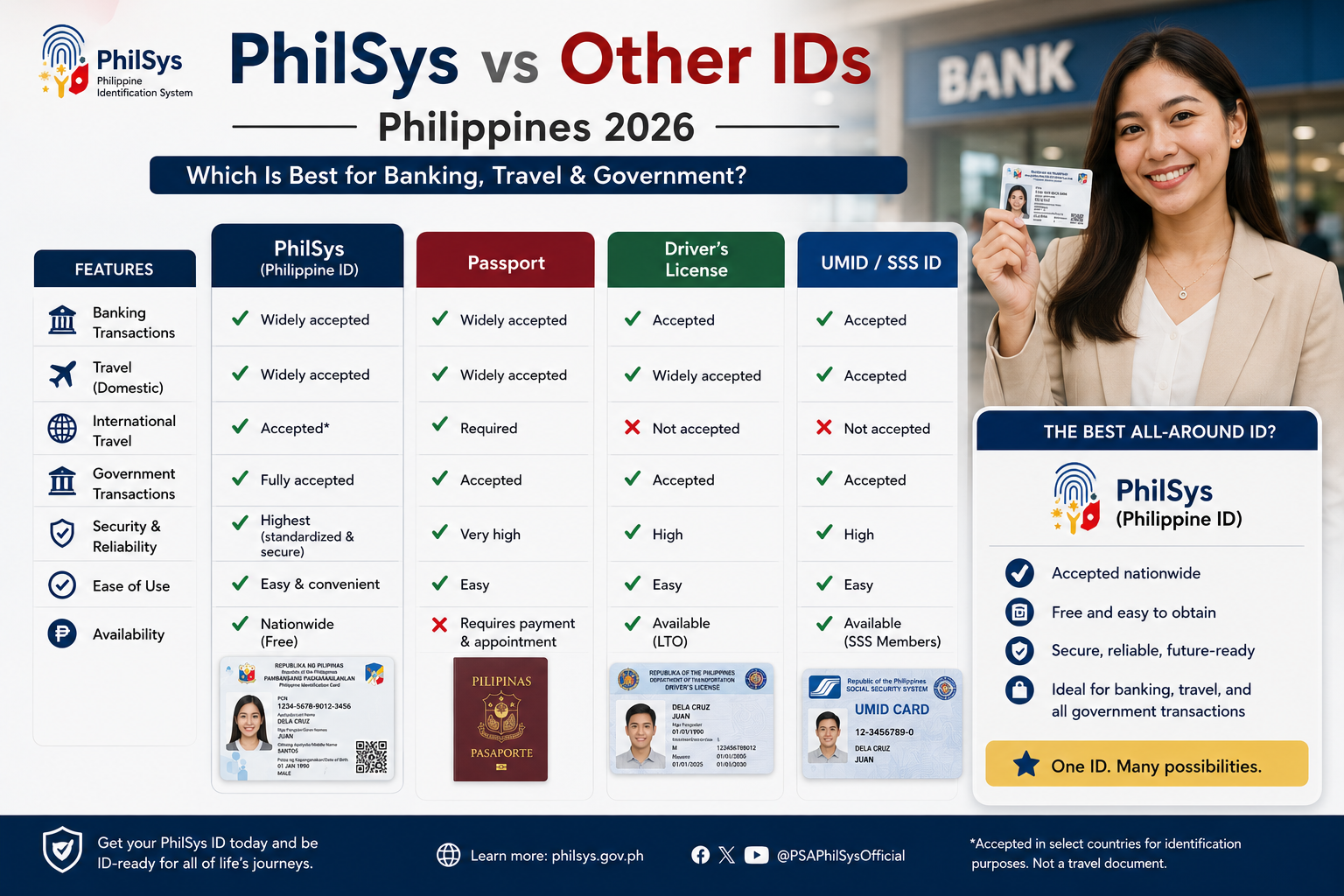
- The PhilSys National ID is the most universally accepted ID in the Philippines for domestic transactions.
- Why This Comparison Matters — And What Changed in 2026
- Which ID Should I Use for This Transaction?
- Full ID Comparison Table — All Major Philippine Government IDs
- Each ID Explained — Strengths, Weaknesses, and When to Use It
- Which ID Should You Get First If You Have None?
- Frequently Asked Questions
- Related Guides and Tools
⚖️ Comparison Guide — Updated July 14, 2026
PhilSys vs Other Philippine IDs — Which Is Best?
PhilSys National ID vs passport, LTO driver’s license, SSS UMID, PhilHealth, and TIN — compared head-to-head on legal strength, acceptance at banks and government agencies, cost to get, and which one to use for specific transactions including GCash, DFA, and BIR.
Quick Answer — Best Philippine Government ID
The PhilSys National ID is the most universally accepted ID in the Philippines for domestic transactions.
It is the only ID mandated by a specific law — Republic Act 11055 — requiring all banks, government agencies, and private institutions to accept it without question. A passport may be required for international travel, but inside the Philippines, no other government ID carries a broader legal mandate than the PhilSys ID. It is also the only major government ID that is completely free to obtain, has no expiry date, and comes with a legally equivalent digital version (ePhilID) available immediately through the eGovPH app.
That said, specific transactions still call for specific IDs — SSS transactions require the UMID, LTO transactions require the driver’s license, and a passport is non-negotiable for international travel. Use the selector below to find the best ID for your exact situation.
Why This Comparison Matters — And What Changed in 2026
Filipinos have been collecting multiple IDs for decades precisely because no single ID was universally accepted everywhere. Showing up at a bank with only a TIN ID or PhilHealth card often wasn’t enough. Applying for a passport required a birth certificate plus a “primary” ID from a specific shortlist. GCash used to reject IDs that banks accepted without question.
The PhilSys National ID was designed to end that fragmentation. Under Republic Act 11055, it is supposed to be the one ID that works everywhere. And largely, it does — but the nuance is in knowing when other IDs are still needed alongside it, and which ID is the practical first choice for each specific transaction type.
This guide answers that question directly: for each major transaction — banking, e-wallets, DFA passport, SSS, PhilHealth, LTO, BIR — which ID should you reach for first, and why?
The Philippine ID Landscape in 2026
As of June 2026, over 90.7 million Filipinos have registered for the PhilSys National ID and more than 54.9 million physical cards have been delivered. The PhilSys ID is now the most widely held government ID in the country by volume — but millions of Filipinos still use older IDs as their primary identification and are unsure whether switching entirely to the National ID is advisable.
The short answer: the National ID should be your primary ID for most transactions. But you should still hold onto your UMID if you are an SSS or GSIS member, keep your passport if you travel internationally, and maintain your driver’s license if you drive. No ID replaces another’s specialized function — but the National ID reduces the list of IDs you need to carry for everyday use to one.
Which ID Should I Use for This Transaction?
Select your transaction type and we’ll tell you which Philippine ID to reach for first — and why.
Opening a Bank Account — Best ID: PhilSys National ID
Under RA 11055, every BSP-regulated bank is legally required to accept the PhilSys National ID as the sole primary ID for account opening. No secondary ID is required by law when you present the PhilID.
Best Choice
Strong Option
Accepted
Secondary Only
GCash / Maya Full Verification — Best ID: PhilSys National ID
The National ID is GCash’s most reliably processed ID and has the lowest rejection rate in the KYC flow. The ePhilID screenshot from the eGovPH app is also accepted — useful if your physical card hasn’t arrived.
Best Choice
Good Option
Accepted
Accepted
DFA Passport Application — Best ID: PhilSys National ID or Passport (renewal)
The PhilSys National ID satisfies the primary ID requirement at DFA. For renewals, your existing passport is the primary document. The National ID is especially useful for first-time applicants who don’t yet have a passport.
Best for First-Time
Best for Renewal
Accepted
ID Only
SSS / GSIS Transactions — Best ID: SSS UMID or GSIS UMID
For SSS and GSIS transactions, the UMID is the primary required document — it is directly linked to your membership record. The National ID covers identity verification but does not replace the UMID for accessing your SSS or GSIS account.
Required
Supplemental
Have Both
LTO Driver’s License Application — Best ID: LTO Driver’s License (renewal) / PhilSys (new)
Your LTO driver’s license is the mandatory document for LTO renewal transactions. For new applicants, the PhilSys National ID satisfies the primary ID requirement alongside the other required LTO documents.
Required for Renewal
Best for New App.
Strong Secondary
BIR / Tax Transactions — Best ID: PhilSys National ID + TIN Card
For BIR transactions, your TIN number is what matters — the TIN ID card itself is a weak standalone ID but the number it contains is required for all tax transactions. Bring both your PhilID (for identity) and your TIN card or any document showing your TIN number.
Best Combination
BIR Counter Only
Not a Primary ID
SIM Registration (Globe / Smart) — Best ID: PhilSys National ID
Under the SIM Registration Act (RA 11934), the PhilSys National ID is the most cleanly accepted ID for Globe, Smart, TNT, and DITO SIM registration — both in-store and online. The ePhilID is accepted for online SIM registration portals.
Best Choice
Accepted
Accepted
Everyday Use (General Valid ID) — Best ID: PhilSys National ID
For general use — hospital, employer, school, private transactions — the PhilSys National ID is the single best card to carry. It is the only ID with a universal legal mandate, has no expiry, and the ePhilID means you don’t need to carry the physical card.
Best All-Around
Strong but Risky
Good Secondary
Full ID Comparison Table — All Major Philippine Government IDs
Every major Philippine government ID compared by seven key criteria. ★ marks the strongest in each category.
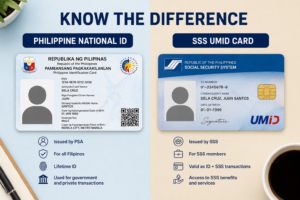
| ID | Legal Mandate | Bank KYC | DFA Passport | GCash / Maya | Cost | Expires? |
|---|---|---|---|---|---|---|
| PhilSys National ID ★ | RA 11055 — Universal mandate ★ | ✓ Primary (sole ID sufficient by law) | ✓ Primary (physical or ePhilID) | ✓ Best (QR verification) ★ | Free ★ | Never (for citizens) ★ |
| Philippine Passport | No domestic mandate | ✓ Primary (universally accepted) | ✓ Required for renewal ★ | ✓ Accepted (slower OCR) | ₱950–₱1,200 | Yes — every 10 years |
| LTO Driver’s License | No domestic mandate | ✓ Primary at most banks | ✓ Primary at DFA | ✓ Accepted (no QR) | ₱585–₱1,000+ | Yes — every 5 years |
| SSS / GSIS UMID | No domestic mandate | ✓ Primary at most banks | ✓ Primary at DFA | ✓ Accepted (slower) | Free (for members) | No expiry |
| PhilHealth ID | No mandate | Secondary only at most banks | ✓ Primary at DFA | ✓ Accepted on some platforms | Free (for members) | No expiry |
| TIN ID | No mandate | ✕ Secondary only — not sufficient as primary | ✕ Not accepted as primary at DFA | ✕ Not accepted for GCash KYC | Free | No expiry |
| Postal ID (PHLPost) | No mandate | Secondary at most banks | Secondary at DFA | Accepted on some platforms | ₱504 | Yes — every 3 years |
| Voter’s ID (COMELEC) | No mandate | Secondary at most banks | Secondary at DFA | Accepted on some platforms | Free | Replaced by new version periodically |
| Senior Citizen ID (OSCA) | No broad mandate | Secondary at most banks | Secondary at DFA | Not accepted for KYC | Free | No expiry but must update on birthday |
Each ID Explained — Strengths, Weaknesses, and When to Use It
PhilSys National ID (PhilID / ePhilID)
Issued by PSA — Philippine Statistics Authority
Philippine Passport
Issued by DFA — Department of Foreign Affairs
LTO Driver’s License
Issued by LTO — Land Transportation Office
SSS / GSIS UMID Card
Issued by SSS (private employees) or GSIS (government employees)
PhilHealth ID
Issued by PhilHealth — Philippine Health Insurance Corporation
TIN ID (BIR)
Issued by BIR — Bureau of Internal Revenue
Which ID Should You Get First If You Have None?
If you are starting from zero — no passport, no UMID, no driver’s license — the answer is straightforward: get the PhilSys National ID first. Here is why it is the correct starting point:
- It requires the fewest pre-existing documents. A PSA birth certificate alone qualifies you for registration. You do not need an existing ID to get a PhilSys ID the way some other IDs require you to present a prior valid ID.
- It is free. No registration fee, no card fee, no delivery fee — zero cost from start to card.
- The digital version is available before the physical card. Once your biometric data is processed, the ePhilID appears in the eGovPH app — usually within 4 to 8 weeks — so you have a legally valid digital ID while the physical card is still in production.
- It unlocks everything else. Once you have the National ID, you can use it to apply for a passport, open a bank account to start SSS contributions (to get a UMID), and register for GCash and Maya. The National ID is the gateway ID.
- It has no expiry. You register once and the ID is valid for life. No renewal cost, no expiry anxiety.
After the National ID, the next priority depends on your situation: drivers need the LTO license, employed workers should get their UMID for SSS access, and frequent international travelers should get a passport. But the National ID comes first because it unlocks everything else and costs nothing.
About this comparison — NationalIDDigital.ph Editorial TeamThe acceptance details, legal citations, and use-case rankings in this guide are based on Republic Act 11055 and its implementing rules, BSP Circulars on PhilSys acceptance, DFA’s official acceptable ID list, and verified acceptance reports from banking and e-wallet KYC processes collected from January to July 2026. This guide is reviewed quarterly and updated when institutional policies change. Last editorial review: July 14, 2026. For official PhilSys information, visit philsys.gov.ph. For BSP banking regulations, visit bsp.gov.ph.
Frequently Asked Questions
Common questions about Philippine government IDs compared — verified July 2026.
window.showVerdict = function (key) { /* Update tabs */ document.querySelectorAll('.use-tab').forEach(function (t) { t.classList.remove('active'); }); event.currentTarget.classList.add('active');
/* Update verdict cards */ document.querySelectorAll('.verdict-card').forEach(function (c) { c.classList.remove('show'); }); var card = document.getElementById('v-' + key); if (card) card.classList.add('show'); };
window.toggleFaq = function (btn) { var item = btn.closest('.faq-item'); var isOpen = item.classList.contains('open'); document.querySelectorAll('.faq-item.open').forEach(function (i) { i.classList.remove('open'); i.querySelector('.faq-question').setAttribute('aria-expanded', 'false'); }); if (!isOpen) { item.classList.add('open'); btn.setAttribute('aria-expanded', 'true'); } };
})();