- Can I Use My National ID for COMELEC Voter Registration?
- IDs Accepted for Voter Registration in the Philippines (2026)
- Is the Voter's ID Card Still Available in the Philippines? (2026 Status)
- What Is a COMELEC Voter's Certification? (The Official Alternative)
- How to Get a Voter's Certification from COMELEC
- Step-by-Step: How to Register as a Voter in the Philippines Using Your National ID
- Philippine National ID vs Voter's ID vs Voter's Certification — Comparison
- Do I Need My Voter's ID or Certification to Vote on Election Day?
- What If I Don't Have Any Valid ID for COMELEC Voter Registration?
- Frequently Asked Questions — National ID and Voter Registration Philippines
- Related Guides on NationalIDDigital.ph
📋 Quick Answer
Yes — your Philippine National ID (PhilID or ePhilID) is accepted for COMELEC voter registration. It is COMELEC’s first-listed valid ID for registration as of 2026. COMELEC no longer issues physical Voter’s ID cards (printing stopped in 2017). Registered voters can request a Voter’s Certification instead — a free, same-day document from any COMELEC office that serves as proof of registration.
If you are about to register as a voter in the Philippines and wondering whether you can use your Philippine National ID (PhilID) or ePhilID at the COMELEC registration site — the answer is yes. COMELEC explicitly accepts the National ID as a valid identification document for voter registration.
But there is more to the story. Many Filipinos still search for how to get a Voter’s ID card, not realizing that COMELEC stopped printing the yellow-and-blue plastic Voter’s ID in 2017. This guide covers the full 2026 picture: what COMELEC currently accepts for registration, what happened to the Voter’s ID, what a Voter’s Certification is, and how your National ID fits into all of it.
Can I Use My National ID for COMELEC Voter Registration?
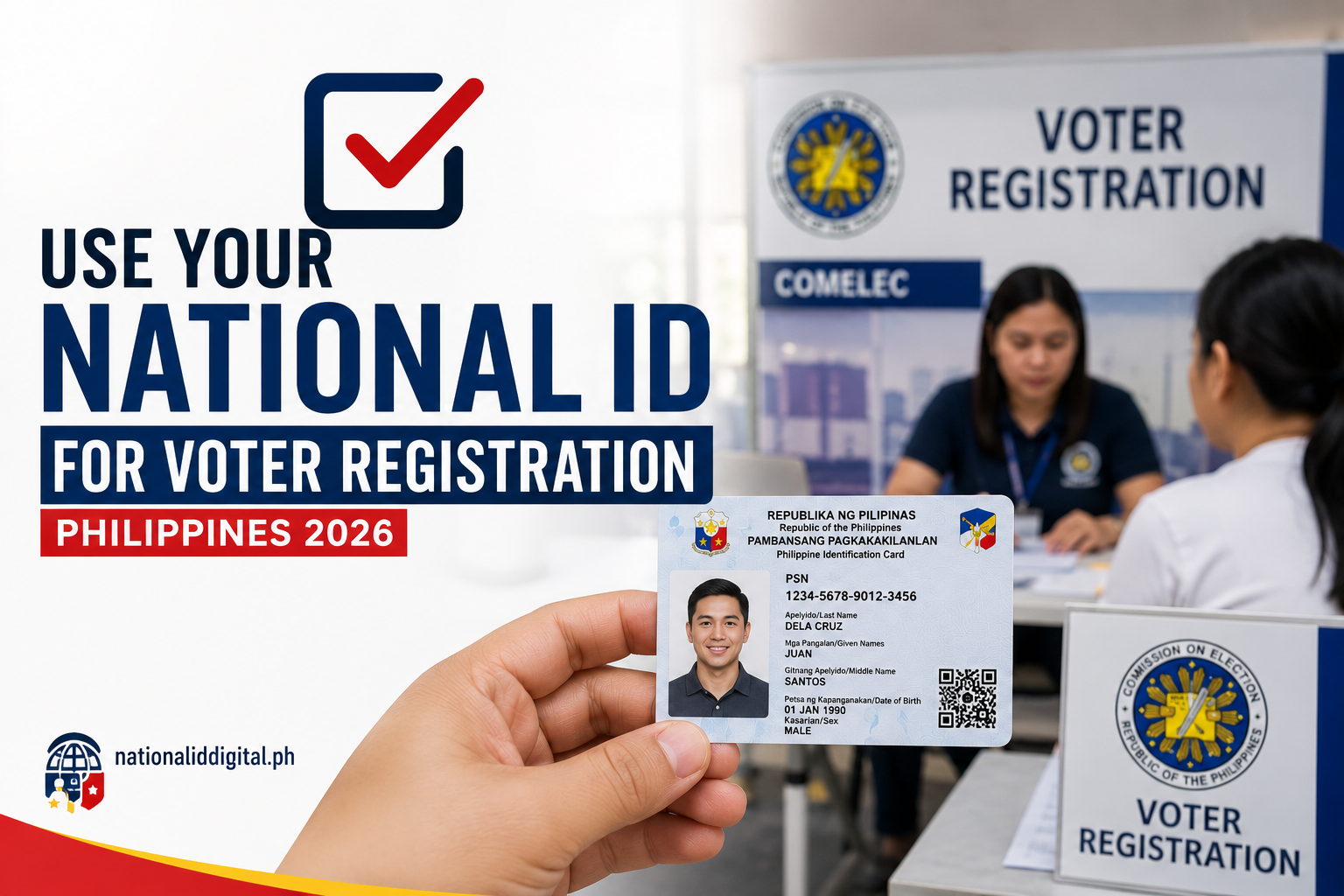
Yes. As confirmed by COMELEC in multiple advisories including its July 2025 and 2024 announcements, the Philippine National ID under the Philippine Identification System (PhilSys) is at the top of COMELEC’s list of accepted IDs for voter registration.
This applies to:
- First-time voter registration — registering for the first time at any COMELEC Office of the Election Officer (OEO) or satellite site
- Transfer of registration — moving your voter record to a new city or municipality
- Reactivation — restoring a deactivated voter registration
- Record correction — updating your name, address, or other details in the COMELEC database
You only need to bring one (1) valid ID from the COMELEC-accepted list. The National ID qualifies as that one ID on its own.
Does the ePhilID Count for COMELEC Registration?
Yes. The ePhilID — the digital version of the National ID accessible through the eGovPH mobile app — carries the same legal validity as the physical PhilID card under Republic Act 11055. If COMELEC staff at your local OEO are unfamiliar with ePhilID, you can show them the QR code and your name and photo on the app screen for verification. Bringing your physical card is always simpler, but the ePhilID is a valid fallback — especially before your physical card arrives.
IDs Accepted for Voter Registration in the Philippines (2026)
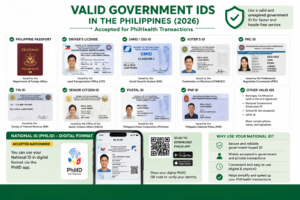
COMELEC reminded the public in July 2025 to bring a valid identification document when applying for voter registration. The following documents are accepted:
| Accepted ID / Document | Has Photo? | Notes |
|---|---|---|
| 🪪 Philippine National ID (PhilID / ePhilID) | ✓ Yes | Top-listed by COMELEC. Fastest to produce for verification. ePhilID via eGovPH app is equally valid. |
| 📮 PHLPost Postal ID | ✓ Yes | Biometric card; widely accepted. One of the fastest IDs to get (3–5 business days). |
| ♿ PWD ID Card | ✓ Yes | Issued by LGU DSWD offices. Valid for persons with disabilities. |
| 🎓 Student ID or Library Card | ✓ Yes | Must be signed by a school authority. Suitable for student and first-time voters. |
| 👴 Senior Citizen’s ID | ✓ Yes | OSCA-issued. Valid for registrants aged 60 and above. |
| 🚗 LTO Driver’s License or Student Permit | ✓ Yes | Widely accepted. One of the most commonly presented IDs at COMELEC registration. |
| 🔵 NBI Clearance | ✓ Yes | Valid for 1 year from issuance. Accepted if still within validity period. |
| 📘 Philippine Passport | ✓ Yes | Universally accepted. Even expired passport may be accepted in some cases — confirm with your OEO. |
| 💳 SSS / GSIS or UMID Card | ✓ Yes | Very commonly used. UMID combines SSS/GSIS/PhilHealth/Pag-IBIG access. |
| ⚖️ IBP ID Card | ✓ Yes | Integrated Bar of the Philippines. For lawyers only. |
| 🏅 PRC Professional License | ✓ Yes | For licensed professionals. Widely accepted across government transactions. |
| 🏛️ NCIP Certificate of Confirmation | No photo | For members of indigenous cultural communities (ICCs) or indigenous peoples (IPs). |
| 🏘️ Barangay ID or Certification with Photo | Photo required | Note: Barangay IDs and barangay certifications without a photo are not accepted for new voter registrations. Must have photo. |
| 📋 Other Government-Issued ID | Varies | Any other valid government-issued ID with your signature. COMELEC election officers have some discretion on acceptance. |
Is the Voter’s ID Card Still Available in the Philippines? (2026 Status)
This is one of the most common sources of confusion about Philippine identification. Here is the direct answer:
❌ COMELEC is no longer issuing physical Voter’s ID cards. Printing of the plastic Voter’s ID card stopped in 2017. As of 2025–2026: no new Voter’s ID cards are issued, no replacement Voter’s ID cards are available, and no digital or online Voter’s ID exists. You cannot apply for a Voter’s ID — online or at any COMELEC office.
Why Did COMELEC Stop Issuing Voter’s ID Cards?
The cessation of printing was a direct preparation for the rollout of the Philippine Identification System (PhilSys). The national government determined it was redundant and a waste of taxpayer resources for COMELEC, SSS, PhilHealth, and Pag-IBIG to all print their own separate ID cards — the goal being to consolidate all basic demographic data into one foundational National ID.
In short: the Philippine National ID was designed to replace the Voter’s ID (and many other separate government IDs) as the single universal government identification for all Filipinos.
But I Still Have My Old Voter’s ID Card — Is It Still Valid?
Yes. Physical Voter’s ID cards that were issued before printing stopped remain valid for transactions that accept them. There is no expiry on the card itself and COMELEC has not declared them invalid. If you have one, you can continue to use it as a secondary ID for government transactions, PhilSys registration, and many other purposes — just confirm with the receiving institution, as some require a more recent or photographic ID.
What Is a COMELEC Voter’s Certification? (The Official Alternative)
If you do not have a physical Voter’s ID card — because you registered after 2017 or never had one issued — the Voter’s Certification is the official document COMELEC provides instead.
A COMELEC Voter’s Certification is an official document issued by COMELEC confirming that a person has a voter registration record. It is printed on COMELEC watermarked letterhead, stamped with COMELEC’s seal, and signed by the local Election Officer.
Key Facts About the Voter’s Certification
- Valid for: One year from the date of its issuance.
- Cost: As of COMELEC’s 2024 fee suspension (Minute Resolution No. 24-0114), issuance and release of Voter’s Certifications are free beginning February 12, 2024.
- Has a photo? No — the Voter’s Certification is a printed text document. It does not contain your photo.
- What it proves: That COMELEC has an active voter registration record under your name. It does not prove you voted in a specific election.
- Accepted as ID? Widely accepted as a supporting identity document for government transactions and PhilSys registration. Due to the absence of a photo, it is generally treated as a secondary or supporting document rather than a standalone primary ID by most banks and agencies.
How to Get a Voter’s Certification from COMELEC
Getting your Voter’s Certification is a quick, same-day process at any COMELEC office. Here are the steps:
- Locate your Office of the Election Officer (OEO).
This is usually at your city hall or municipal hall. You must go to the OEO in the city or municipality where you are registered — not necessarily where you currently live. Metro Manila residents registered in the provinces have an alternative option (see below). - Bring one valid government-issued ID.
Your National ID (PhilID or ePhilID) is sufficient. Any other ID from the COMELEC-accepted list also works. - Fill out the request form.
Ask the COMELEC staff for a Voter’s Certification request form. Fill in your full registered name and current address. - Wait for printing and release.
The certification is typically printed and handed to you on the same visit. Processing takes 15 to 30 minutes in most offices during non-peak periods. - Check the document carefully before leaving.
Before you leave the COMELEC office, check the certificate carefully. If your name is misspelled or your civil status is outdated, do not assume it can be corrected instantly — COMELEC may require a proper application for correction or updating of voter registration record during the appropriate registration period.
Step-by-Step: How to Register as a Voter in the Philippines Using Your National ID
Voter registration in the Philippines is not a year-round activity. COMELEC opens registration periods in advance of elections — typically several months before a scheduled election date. Always check the COMELEC website (comelec.gov.ph) for current registration schedules before planning your visit.
When a registration period is open, here is the process:
- Confirm your eligibility.
You must be a Filipino citizen, at least 18 years old on or before the day of the election you are registering for, a resident of the Philippines for at least one year, and a resident of the specific place where you plan to vote for at least six months before election day. - Prepare your National ID.
Bring your physical PhilID card or have your ePhilID ready on the eGovPH app. Either is accepted. If you do not have your physical card yet, download your ePhilID first — it takes 4 to 8 weeks after biometrics. - Find your registration site.
Visit the Office of the Election Officer (OEO) in your city or municipality. COMELEC also conducts satellite registrations at malls, barangay halls, schools, and other public locations during registration periods. Check COMELEC’s social media pages for satellite registration schedules in your area. - Fill out the Voter Registration Form (CEF-1).
This form asks for your full name, date of birth, address, civil status, and other personal details. You will also sign the form and have your biometrics (photo, fingerprint, and signature) captured by the COMELEC officer. - Present your National ID for verification.
Hand your PhilID or show your ePhilID to the election officer. They will verify your identity and cross-check your details against the COMELEC database. - Receive your acknowledgment slip.
After submitting your application, you will receive an acknowledgment stub. Keep this — it serves as proof of filing while your application is being processed in the system. - Verify your registration status online.
After the registration period closes, you can verify whether your registration was approved through the COMELEC voter verification portal at comelec.gov.ph. It may take several weeks for new registrations to appear in the system.
Philippine National ID vs Voter’s ID vs Voter’s Certification — Comparison
| Feature | 🪪 National ID (PhilID) | 🗳️ Voter’s ID Card | 📄 Voter’s Certification |
|---|---|---|---|
| Currently issuable? | ✓ Yes — free | ✗ No — stopped 2017 | ✓ Yes — free (since Feb 2024) |
| Has photo? | ✓ Yes | ✓ Yes (old cards) | ✗ No |
| Validity period | Lifetime | No expiry (old cards) | 1 year from issuance |
| Accepted by banks? | ✓ Yes — primary ID | Usually as 2nd ID | Usually not — no photo |
| Accepted for GCash/Maya KYC? | ✓ Yes | Sometimes | ✗ No — no photo |
| Accepted for PhilSys registration? | ✓ Yes | ✓ Yes | ✓ Yes (as supporting doc) |
| Legal basis | RA 11055 — universal acceptance mandated | RA 8189 (Voter’s Registration Act) | COMELEC resolutions and IRR |
| Digital version available? | ✓ ePhilID via eGovPH app | ✗ No | ✗ No official digital version |
Do I Need My Voter’s ID or Certification to Vote on Election Day?
This is another common question. The short answer is: you do not need to present a Voter’s ID card on election day to cast your ballot.
On election day, the Board of Election Inspectors (BEI) verifies your identity using the Voter’s List for your precinct, which contains your name, your captured photo from biometrics registration, and your signature. The BEI will have you sign alongside your signature on file to confirm your identity.
However, having a valid ID — such as your National ID — is always a good idea to bring on election day in case the BEI needs to confirm your identity, especially if your appearance has significantly changed since your registration photo was taken.
What If I Don’t Have Any Valid ID for COMELEC Voter Registration?
If you have no ID from the COMELEC-accepted list, here are your fastest options:
Option 1 — Get Your ePhilID (Fastest If Already Registered for National ID)
If you have already completed Step 2 biometrics for your National ID, your ePhilID is typically available 4 to 8 weeks later via the eGovPH app — no physical card needed. Use our ePhilID Eligibility Checker to see if yours is ready now.
Option 2 — Get the PHLPost Postal ID (Fastest Physical Card)
The Postal ID is one of the fastest government-issued photo IDs to get in the Philippines — typically 3 to 5 business days after application at your local post office. Requirements: PSA Birth Certificate and proof of address. It is on COMELEC’s accepted list and also accepted by many banks.
Option 3 — Apply for Your National ID First (Best Long-Term)
If you have neither a National ID nor any other ID, registering for your Philippine National ID first makes the most sense. It is free, has lifetime validity, and once you have your ePhilID or physical card, it will serve as your primary ID for every transaction — including COMELEC voter registration — for the rest of your life. Use our Requirements Checklist Generator to see what documents you need for PhilSys registration even without a primary ID.
Frequently Asked Questions — National ID and Voter Registration Philippines
Can I use my National ID for voter registration in the Philippines?
Yes. The Philippine National ID (PhilID) is explicitly listed by COMELEC as a valid identification document for voter registration. COMELEC considers the national ID under the Philippine Identification System as a valid identification document for registration purposes. You only need to bring one valid ID, and the National ID qualifies on its own. The ePhilID (digital version via the eGovPH app) is equally valid under RA 11055.
Is the Voter’s ID card still valid in the Philippines in 2026?
COMELEC has stopped issuing Voter’s ID cards. As of 2025–2026, no new Voter’s ID cards are issued, no replacement cards are available, and no digital or online Voter’s ID exists. Printing officially stopped in 2017. However, physical Voter’s ID cards issued before printing stopped remain valid for transactions that accept them. New and updating registrants receive a Voter’s Certification instead — a free, printed document valid for one year.
How do I get a Voter’s Certification from COMELEC?
Visit the Office of the Election Officer (OEO) in the city or municipality where you are registered. Bring one valid government-issued ID, fill out the request form, and the certification is typically printed and released on the same visit. As of COMELEC’s 2024 fee suspension (Minute Resolution No. 24-0114), issuance and release of Voter’s Certifications are free beginning February 12, 2024. The certification is valid for one year from the date of issuance.
What IDs does COMELEC accept for voter registration?
Considered as valid identification documents are: national ID, postal ID card, PWD card, student’s ID or library card, senior citizen’s ID, and driver’s license or student permit. Also acceptable are NBI clearance, Philippine passport, SSS/GSIS or UMID card, IBP ID card, PRC license, and Certificate of Confirmation from the NCIP. Barangay certifications with photo are also accepted. Barangay IDs or certifications without a photo are not accepted for new voter registrations.
Do I need my Voter’s ID to vote on election day in the Philippines?
No. On election day, the Board of Election Inspectors (BEI) verifies your identity through the precinct voter list, which contains your registered name, photo, and signature from your biometrics capture. You will be asked to sign beside your signature on file. A Voter’s ID card or Voter’s Certification is not required to cast your ballot, though bringing a valid ID (such as your National ID) is always recommended for additional identity verification if needed.
Can I use my Voter’s Certification to open a bank account in the Philippines?
Generally, no — not as a standalone primary ID. The Voter’s Certification does not have a photo, which means most banks will not accept it as a primary ID for account opening KYC. It may be accepted as a secondary supporting document alongside a photo ID in some cases. If you need an ID for banking, the Philippine National ID (PhilID or ePhilID) is your best option — it is legally mandated for acceptance by all BSP-regulated banks under RA 11055. See our National ID for bank account guide.
Related Guides on NationalIDDigital.ph
🪪
How to Apply for a National IDComplete registration guide
📲
Download Your ePhilIDGet your digital National ID via eGovPH
✅
ePhilID Eligibility CheckerCan you download yours yet?
🔍
National ID Acceptance CheckerWhere is your PhilID accepted?
🏦
National ID for Bank AccountOpen a bank account with your PhilID
🔵
National ID for NBI ClearanceWhat to bring, ePhilID limits at NBI
📋
PhilSys Requirements ChecklistKnow exactly what to bring to registration
✏️
Correct Wrong Data on Your National IDName, birthday, address corrections
🔧
National ID Problem SolverTroubleshoot ID issues and errors
📚 Sources & References
- Republic Act 11055 — Philippine Identification System Act (2018) — legal basis for PhilID/ePhilID universal acceptance
- Republic Act 8189 — The Voter’s Registration Act of 1996 — governs voter registration and Voter’s ID
- COMELEC Minute Resolution No. 24-0114 — fee suspension for Voter’s Certification (February 2024)
- COMELEC social media advisory, July 29, 2025 — list of valid IDs for voter registration
- COMELEC en banc Resolution, September 25, 2024 — temporary suspension of certification issuance on September 30, 2024
- Philippine News Agency (PNA) — COMELEC voter’s certification free of charge starting Feb. 12, 2024
- COMELEC BSKE 2026 registration advisory — valid IDs and schedule (May 2026)
- PSA PhilSys.gov.ph — National ID registration and ePhilID information (2026)
NationalIDDigital.ph is an independent guide not affiliated with COMELEC, PSA, or any government agency. Last reviewed: July 2026. Always confirm current COMELEC registration periods and requirements at comelec.gov.ph.