If you’ve ever stood at a bank counter or an SSS branch and been asked “do you have your UMID?” right after presenting your National ID, you’re not alone. Both are legitimate government-issued IDs, but they’re built for different purposes — and mixing them up can mean an extra trip back home for the right card.
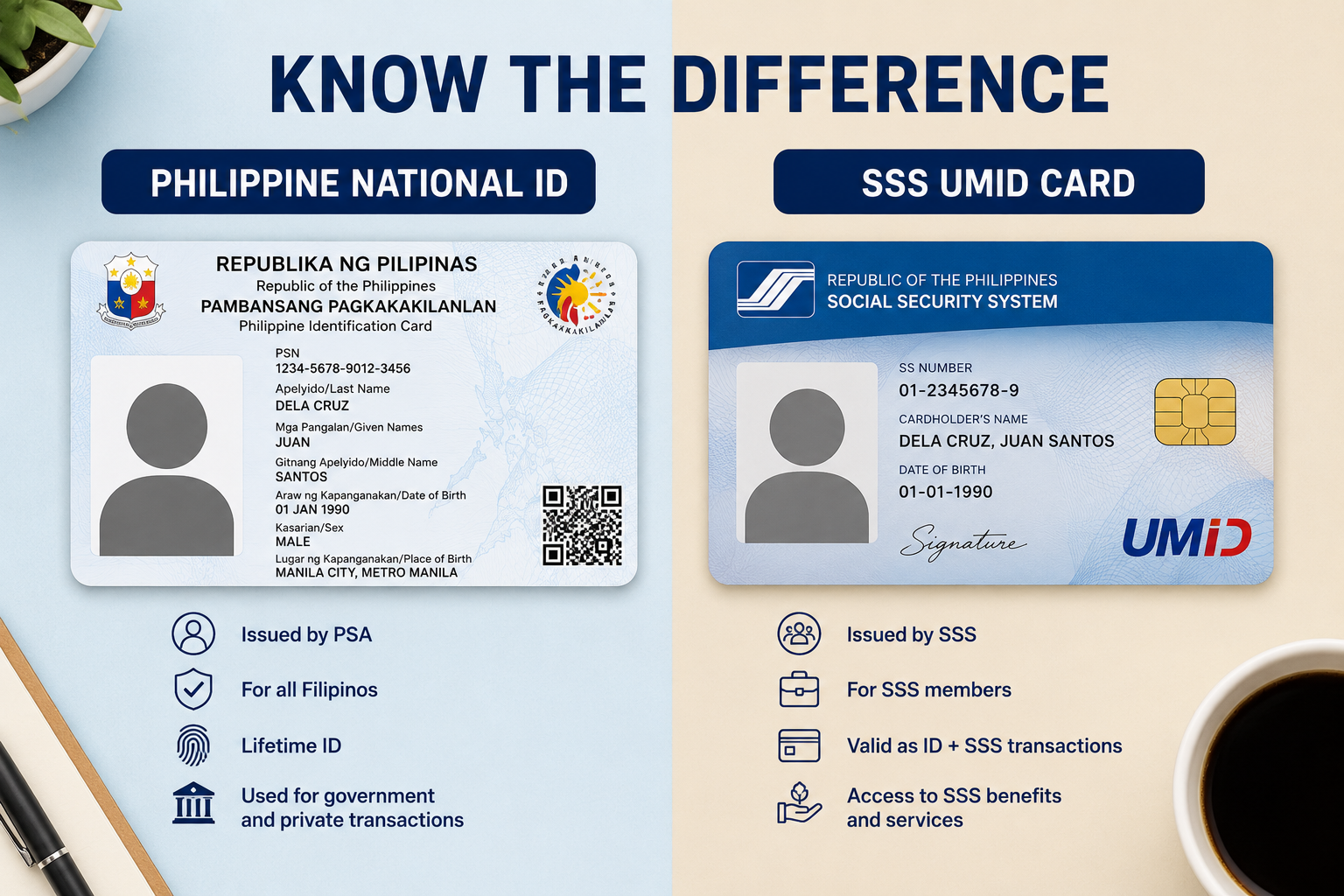
The short version: your National ID (PhilID) is the broader, all-purpose government ID issued to every Filipino citizen. Your SSS UMID is a membership-specific ID tied to your SSS, GSIS, PhilHealth, or Pag-IBIG records, and it’s still required for most SSS-specific transactions even if you already have a National ID. This guide breaks down exactly when you need which one — and whether you really need both.
National ID vs SSS UMID: Side-by-Side Comparison
| Feature | National ID (PhilID) | SSS UMID |
|---|---|---|
| Issued by | PSA (Philippine Statistics Authority) | SSS, in coordination with GSIS, PhilHealth & Pag-IBIG |
| Who can get one | All Filipino citizens (and resident aliens, with limitations) | SSS members only (employed, self-employed, voluntary, OFW) |
| Valid for bank KYC | Yes — explicitly recognized under RA 11055 | Yes |
| Valid for SSS transactions | Limited — accepted for identity verification in some cases, but not a full substitute | Required for most SSS over-the-counter and online transactions |
| Valid for SSS loan applications | ID purposes only | Required as a primary requirement |
| Valid for passport application | Yes | Yes, typically as a secondary/supporting ID |
| Physical card | Yes | Yes |
| Digital version | ePhilID (via eGovPH / PhilSys app) | My.SSS / UMID-linked digital access |
| Validity period | Lifetime | Lifetime (tied to active SSS membership status) |
| Cost to obtain | Free | Free |
ℹ️
The National ID is a general government ID for all citizens; the SSS UMID is a membership ID tied specifically to your SSS (and linked GSIS/PhilHealth/Pag-IBIG) records. For SSS transactions like loans and contributions, the UMID is still required even if you have a National ID.
Section 1: When You MUST Use the UMID
There are several transaction types where the UMID isn’t optional — your National ID won’t be accepted as a substitute, no matter how recently you got it.
- SSS salary, calamity, or pension loan applications — UMID is a standard requirement, often alongside other documents.
- SSS contribution verification at branches — branch staff typically ask for UMID first since it’s directly linked to your SSS records.
- Employer-initiated SSS transactions — HR departments processing loan applications or benefit claims on your behalf usually require a UMID number and card copy.
- Biometric-linked SSS online services — some online verification steps reference your UMID-linked biometric data specifically.
If you’re an active SSS member and don’t yet have a UMID, this is the card you should prioritize getting before your next loan or benefits transaction — a National ID won’t unblock these specific processes.
Section 2: When the National ID Is the Better Choice
For most day-to-day identity verification outside the SSS ecosystem, the National ID is now the more broadly accepted — and often preferred — option.
- Opening a bank account: National ID is explicitly recognized for KYC (Know Your Customer) requirements under RA 11055, and many banks now list it as a preferred primary ID.
- GCash, Maya, and other e-wallet verification: National ID is widely accepted for identity tier upgrades and KYC checks.
- Passport application: Accepted as a primary supporting document.
- Non-SSS government transactions: LGU services, COMELEC-related processes, and most agency-to-citizen transactions accept the National ID as sufficient standalone ID.
- If you’re not an SSS member at all (e.g., not currently employed or self-employed under SSS coverage), the National ID is your most relevant general-purpose ID by default.
Section 3: Do You Need Both?
If you’re an active or former SSS member, the honest answer is: ideally, yes, you should have both — but not because they’re redundant. They simply don’t overlap completely.
✅
Keep your National ID for everything general — banking, e-wallets, passports, most government offices. Keep your UMID specifically for SSS-related transactions. If you only ever interact with SSS through your employer and never personally file loans or claims, you can deprioritize getting a UMID — but don’t cancel one you already have.
If you’re not an SSS member and have no plans to be (e.g., you’re not currently working in a covered employment arrangement), the National ID alone is sufficient for the vast majority of personal and financial transactions.
Section 4: Can You Use One ID to Get the Other?
Can I use my National ID to apply for a UMID?
Yes — your National ID can serve as one of your supporting identification documents when applying for a UMID through SSS, alongside your SSS number and membership records. It does not replace the UMID application process itself, since the UMID is tied to your SSS biometric enrollment specifically.
Can I use my UMID to apply for a National ID?
Yes — a UMID is accepted as a valid supporting ID document during PhilSys registration if you don’t already have other primary documents on hand. It can help speed up verification, but you’ll still go through the standard PSA registration process (biometric capture, demographic data collection) since the National ID has its own independent registry.
Interactive Checker: Which ID Do I Need?
Select the transaction you’re trying to complete, and this tool will tell you which ID to bring.
var answers = { bank: { id: 'National ID', detail: 'Banks widely accept the National ID for KYC under RA 11055. UMID also works, but National ID is usually preferred.' }, ewallet: { id: 'National ID', detail: 'GCash, Maya, and most e-wallets accept the National ID for identity tier upgrades.' }, sssloan: { id: 'SSS UMID', detail: 'SSS loan applications require the UMID — your National ID alone will not be accepted as a substitute here.' }, ssscontrib: { id: 'SSS UMID', detail: 'For contribution verification at SSS branches, bring your UMID — it\'s directly linked to your SSS records.' }, passport: { id: 'Either works', detail: 'Both the National ID and UMID are accepted for passport applications, with National ID typically used as primary.' }, employer: { id: 'SSS UMID', detail: 'Employer-filed SSS transactions (loans, claims) typically require your UMID number and card copy.' }, lgu: { id: 'National ID', detail: 'Most LGU and general government transactions accept the National ID as sufficient standalone ID.' }, pension: { id: 'SSS UMID', detail: 'SSS pension and benefit claims require the UMID as a primary requirement.' } };
select.addEventListener('change', function(){ var val = select.value; if (!val) { result.style.display = 'none'; return; } var a = answers[val]; result.style.display = 'block'; if (a.id === 'SSS UMID') { result.style.background = 'rgba(245,166,35,0.12)'; result.style.color = '#b57c0a'; result.style.border = '1px solid rgba(245,166,35,0.3)'; } else if (a.id === 'National ID') { result.style.background = 'rgba(26,77,183,0.08)'; result.style.color = '#1a4db7'; result.style.border = '1px solid rgba(26,77,183,0.2)'; } else { result.style.background = 'rgba(26,122,69,0.08)'; result.style.color = '#1a7a45'; result.style.border = '1px solid rgba(34,160,90,0.25)'; } result.innerHTML = '✅ Bring your ' + a.id + '. ' + a.detail; }); })();
Frequently Asked Questions
Is the National ID the same as the SSS UMID?
No. The National ID is a general-purpose government ID issued by PSA to all Filipino citizens. The UMID is issued by SSS and is tied specifically to your SSS (and linked GSIS/PhilHealth/Pag-IBIG) membership records.
Can I use my National ID instead of UMID for SSS transactions?
For most SSS-specific transactions like loans, contribution checks, and benefit claims, no — the UMID is still required. The National ID works for general identity verification but isn’t a full substitute for SSS purposes.
Do I need both a National ID and a UMID?
If you’re an active or former SSS member, it’s worth having both, since they cover different transaction types. If you’re not an SSS member, the National ID alone is typically sufficient.
Which one is better for opening a bank account?
The National ID is explicitly recognized for bank KYC requirements under RA 11055 and is often the preferred ID, though UMID is also accepted by most banks.
Can I get a UMID using my National ID as proof of identity?
Yes, your National ID can serve as a supporting document in your UMID application, alongside your SSS membership records.
Which ID do I need for a passport application?
Both are accepted. The National ID is typically used as the primary ID, with the UMID as a secondary/supporting document if needed.
Is the UMID free to get?
Yes, like the National ID, the UMID is free to apply for through SSS.
Does my UMID expire?
The UMID itself does not have an expiration date, but its usefulness depends on your SSS membership remaining active and up to date.
Can I use GCash or Maya with just my National ID?
Yes, the National ID is widely accepted by e-wallet providers for identity verification and KYC tier upgrades.
What if I lost my UMID — can my National ID cover me in the meantime?
For general identity purposes, yes. But for SSS-specific transactions like loans or contribution-related processes, you’ll likely still need to report the loss and request a replacement UMID through SSS.
Still deciding which government ID to prioritize first? See our full National ID application guide, or check the official SSS website for current UMID enrollment requirements.