- National ID Size Tool — Check CM, Inches, MM & Compare
- Why the PhilID Uses the CR80 Standard
- CR80 vs. CR79 vs. CR100: Full Format Comparison
- What's Actually Printed on the Card
- Card Thickness & Material
- National ID Size vs. Other Philippine Government IDs
- Three Formats, One Size Rule: Physical Card, ePhilID, and Digital ID
- Designing a CR80-Format Card? Full Print Specs
- Frequently Asked Questions
- Related National ID Guides
National ID Size in the Philippines: CM, Inches & MM Explained (2026)
National ID Size Tool — Check CM, Inches, MM & Compare
Pick a unit and a comparison card. The tool below calculates the figure live, so you can check exact dimensions, print margins, or how the PhilID compares to whatever card is already in your wallet.
function mmTo(unit, mm) { if (unit === "cm") return (mm / 10).toFixed(2) + " cm"; if (unit === "inches") return (mm / 25.4).toFixed(3) + '"'; return mm.toFixed(2) + " mm"; }
function render() { var unit = document.getElementById("unit-select").value; var compareKey = document.getElementById("compare-select").value;
document.getElementById("philid-value").textContent = mmTo(unit, PHILID_MM.w) + " \u00d7 " + mmTo(unit, PHILID_MM.h);
var compareCardEl = document.getElementById("compare-card"); var visualCompareEl = document.getElementById("visual-compare"); var verdictEl = document.getElementById("result-verdict");
if (compareKey === "none") { compareCardEl.style.display = "none"; visualCompareEl.style.display = "none"; verdictEl.textContent = ""; return; }
var card = CARDS[compareKey]; compareCardEl.style.display = "block"; document.getElementById("compare-label").textContent = card.name; document.getElementById("compare-value").textContent = mmTo(unit, card.mm.w) + " \u00d7 " + mmTo(unit, card.mm.h); verdictEl.innerHTML = card.note;
// scale visual boxes proportionally (px per mm, capped for layout) var scale = 3.2; var philEl = document.getElementById("visual-philid"); philEl.style.width = (PHILID_MM.w * scale) + "px"; philEl.style.height = (PHILID_MM.h * scale) + "px";
visualCompareEl.style.display = "flex"; visualCompareEl.style.width = (card.mm.w * scale) + "px"; visualCompareEl.style.height = (card.mm.h * scale) + "px"; visualCompareEl.textContent = card.name; }
document.getElementById("unit-select").addEventListener("change", render); document.getElementById("compare-select").addEventListener("change", render); render(); })();
Tool note: figures are based on the official CR80/ISO 7810 ID-1 specification (85.60 × 53.98 mm) and publicly documented dimensions for each comparison card. This is a reference tool, not an official PSA measurement service.
Why the PhilID Uses the CR80 Standard
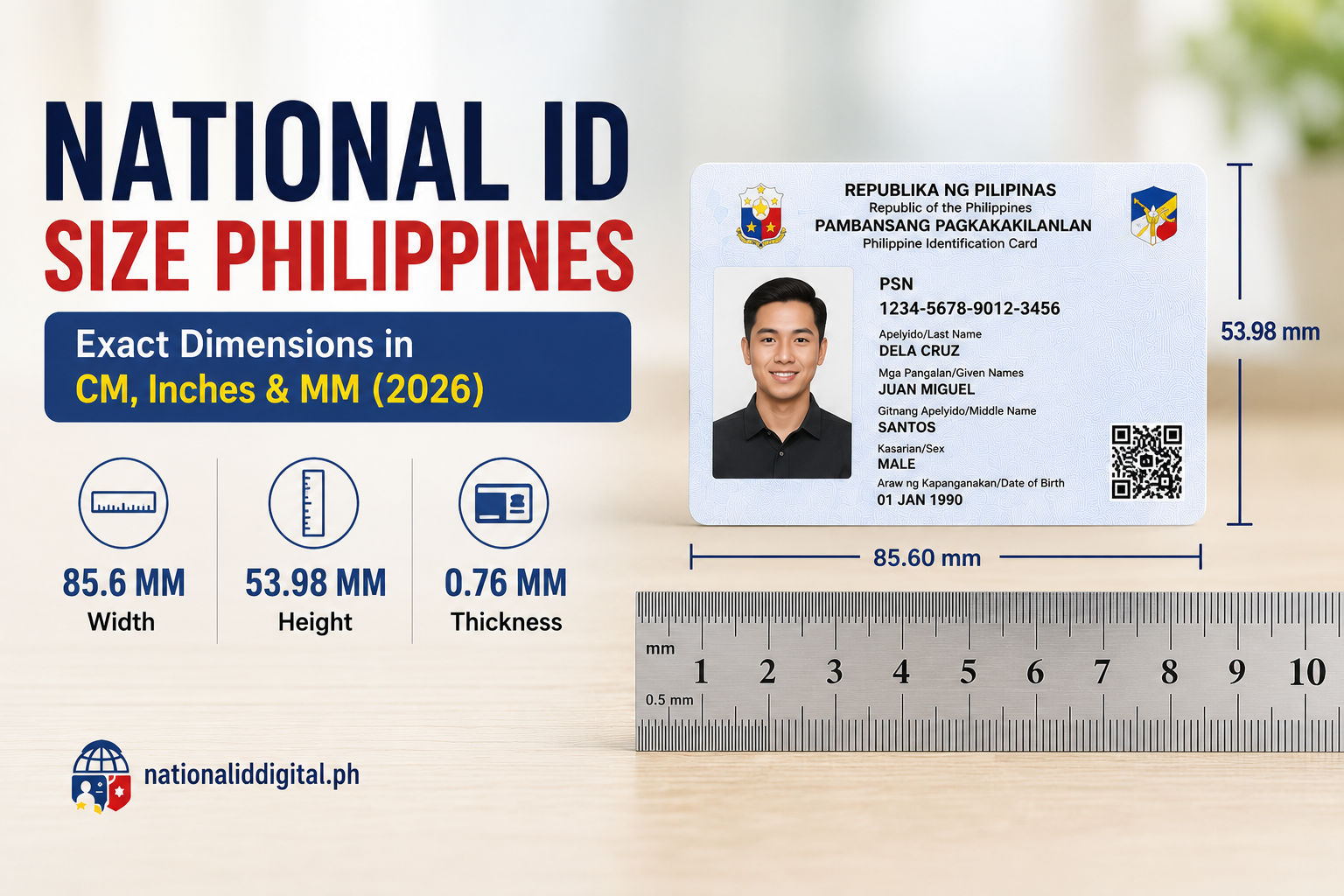
Every PhilSys card traces its dimensions back to one international spec: ISO/IEC 7810 ID-1, more commonly called CR80 in the card-printing industry. It’s the same designation that governs your bank card, most driver’s licenses worldwide, and the majority of national ID programs outside the Philippines.
The Philippine government didn’t pick this size arbitrarily. Republic Act No. 11055, which created PhilSys, effectively locks the PhilID into a format that already has global infrastructure built around it:
- Wallet compatibility — every card slot manufactured for a bank card already fits the PhilID. No special sleeve or holder needed.
- Reader compatibility — card readers at banks, airports, and government counters are already built for CR80 dimensions.
- Cross-border verification — because most countries’ national IDs share this format, the PhilID is legible to systems built for other countries’ cards too, which matters for OFWs and dual-use verification.
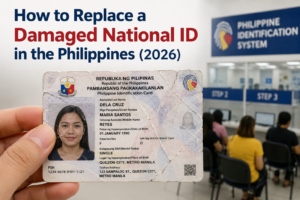
How to Replace a Damaged National ID Size in the Philippines (2026)
CR80 vs. CR79 vs. CR100: Full Format Comparison
If you’re designing or sourcing ID cards rather than just checking your PhilID, here’s how the three formats you’ll encounter most often actually differ:
| Format | Size (mm) | Size (inches) | Where you’ll see it |
|---|---|---|---|
| CR80 (ID-1) | 85.60 × 53.98 | 3.375″ × 2.125″ | National IDs, bank cards, driver’s licenses |
| CR79 | 84.00 × 52.00 | 3.303″ × 2.051″ | Proximity access cards, clamshell inserts |
| CR100 | 100.00 × 70.00 | 3.88″ × 2.63″ | Military IDs, large-format event badges |
A CR79 card will sit loosely in a wallet slot built for CR80. A CR100 card won’t fit a standard slot at all. CR80 is the only one of the three built specifically around everyday carry, which is exactly why it’s the default for government-issued ID worldwide.
What’s Actually Printed on the Card
Knowing the layout helps you both use the card correctly and recognize a genuine one.
Front of the PhilID
The front carries the Republic of the Philippines coat of arms, the PSA logo, and your 16-digit PhilSys Card Number (PCN) at the bottom. Your photo, full name, date of birth, and address are laser-engraved rather than printed — along with guilloche patterns, microprinting, and color-shifting ink as anti-counterfeiting measures. Unlike most other Philippine government IDs, the PhilID does not carry a handwritten signature.
Back of the PhilID
The back holds a scannable QR code, your sex, blood type, optional marital status, place of birth, date of issue, and a serial number. Your permanent 12-digit PhilSys Number (PSN) is not printed in full — it’s embedded in microprint and encoded in the QR code.
Card Thickness & Material
Thickness in the card industry is measured in mils (thousandths of an inch). The PhilID sits at the standard 30 mil — the same as most bank cards — but the material underneath is different.
| Thickness | Millimeters | Typical use |
|---|---|---|
| 10 mil | 0.25 mm | Flexible, temporary event badges |
| 20 mil | 0.51 mm | Gift cards, hotel key cards |
| 30 mil | 0.76 mm | National IDs, credit cards, driver’s licenses |
| 40 mil | 1.02 mm | Heavy-duty access cards, military IDs |
The PhilID uses polycarbonate, not the PVC found in most bank cards. Polycarbonate is stiffer and more tamper-resistant at the same thickness — it’s why the card feels less flexible than a typical credit card even though the numbers match.
National ID Size vs. Other Philippine Government IDs
| Philippine ID | Size (cm) | Format |
|---|---|---|
| PhilSys National ID | 8.56 × 5.40 | CR80 / ISO ID-1 |
| Driver’s License (LTO) | 8.56 × 5.40 | CR80 / ISO ID-1 |
| UMID Card (SSS/GSIS) | 8.56 × 5.40 | CR80 / ISO ID-1 |
| Postal ID | 8.56 × 5.40 | CR80 / ISO ID-1 |
| Voter’s ID (discontinued) | Varies by print batch | Non-CR80, printing stopped 2017 |
| Passport (data page) | 12.50 × 8.80 | ISO ID-3 (booklet) |
Three Formats, One Size Rule: Physical Card, ePhilID, and Digital ID
PhilSys issues the National ID in three formats, and only one of them follows a fixed physical size:
- Physical PhilID card — the polycarbonate CR80 card delivered by PHLPost. This is the primary, fixed-size format.
- ePhilID — a paper printout on standard A4/letter security paper, issued right after biometric capture. Considerably larger than the card; some people laminate and trim theirs, though PSA doesn’t officially recommend it.
- Digital National ID (via the eGovPH app) — no fixed size at all. It renders to fit whatever screen it’s displayed on, with a dynamic QR code for real-time verification.
Designing a CR80-Format Card? Full Print Specs
If you’re producing an employee badge, membership card, or event pass in the same universal size as the PhilID — not a replica of the PhilID itself — here’s the working spec:
| Spec | Value |
|---|---|
| Canvas size (with bleed) | 8.89 × 5.72 cm (3.5″ × 2.25″) |
| Trimmed final size | 8.56 × 5.40 cm (3.375″ × 2.125″) |
| Bleed margin | 1.5 mm all sides |
| Safe zone from trim edge | 3 mm minimum |
| Corner radius | 2.88–3.48 mm |
| Resolution | 300 DPI minimum, CMYK |
Frequently Asked Questions
What is the exact size of the Philippine National ID?
It follows the CR80/ISO 7810 ID-1 card standard — the same footprint as a bank card. Use the interactive size tool above to see the figure converted to your preferred unit and compared against other cards.
Is the National ID Size the same size as a credit card?
Yes, in width and height. The difference is the card material — see the thickness & material section for why the PhilID feels stiffer than a typical bank card.
How thick is the Philippine National ID card?
It’s built to the standard card thickness used across most government and bank cards. Full comparison with thinner and heavier card stock is in the thickness table above.
What’s the difference between CR80, CR79, and CR100?
Three different ISO card formats for different purposes — see the full format comparison table for exact dimensions and where each is used.
Does the ePhilID or Digital National ID follow the same size as the physical card?
No — only the physical card has a fixed CR80 size. The three-format breakdown above explains how the paper and digital versions differ.
Can I print my own National ID at home?
No — only the PSA can legally produce the physical card, and home replication is not achievable given the card’s security features. If you’re waiting on delivery, the Digital National ID is a valid interim option; see the formats section above.
What canvas size and bleed should I use for a CR80-format card?
See the full print-template specification table above for canvas size, bleed, safe zone, corner radius, and resolution.