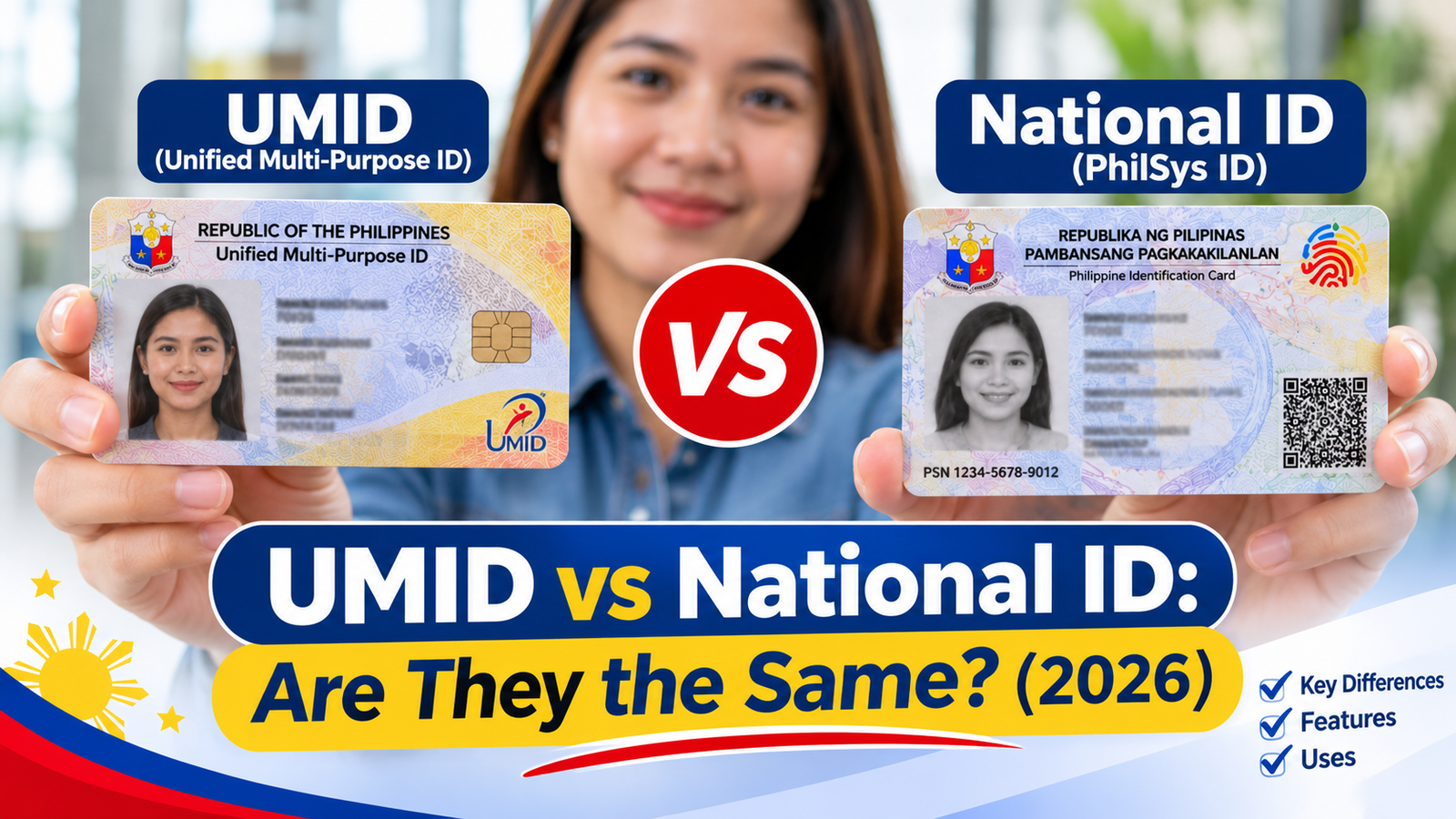
- UMID vs National ID at a Glance
- What Is the UMID?
- What Is the National ID (PhilSys)?
- Is the UMID Still Issued in 2026?
- UMID vs National ID: Which One Should I Use?
- Can I Have Both a UMID and a National ID?
- Card Size: UMID vs National ID
- UMID, SSS Number, CRN, and National ID Number — Do Not Mix Them Up
- Frequently Asked Questions
- Sources and Accuracy Note
UMID vs National ID at a Glance
| UMID | National ID (PhilSys) | |
|---|---|---|
| Full name | Unified Multi-Purpose Identification card | Philippine Identification System (PhilSys) National ID — PhilID |
| Legal basis | Executive Order No. 420 (2005) | Republic Act No. 11055, the PhilSys Act (2018) |
| Issued by | SSS or GSIS (for their members) | Philippine Statistics Authority (PSA) through PhilSys |
| Who can get one | Members of SSS, GSIS, Pag-IBIG or PhilHealth who qualify | Filipino citizens and resident aliens |
| Main purpose | One card for SSS, GSIS, Pag-IBIG and PhilHealth transactions | One foundational ID for all government and private transactions |
| Card number | 12-digit Common Reference Number (CRN) | 12-digit PhilSys Number (PSN); the physical card also carries a 16-digit PhilSys Card Number (PCN) |
| Card size | 8.56 × 5.40 cm — CR80 / ISO ID-1 | 8.56 × 5.40 cm — CR80 / ISO ID-1 |
| Still issued? | Old UMID: largely replaced for new applicants — see below | Yes — registration continues at PhilSys centres |
| Primary ID? | Valid primary ID, but agency-specific | Primary official identification for Filipinos |
The size row surprises most people: the two cards are physically identical in size. If you hold them side by side, the difference is not the dimensions — it is the system behind the card.
What Is the UMID?
The Unified Multi-Purpose ID was introduced to stop Filipinos carrying a separate ID for every agency. One UMID card was meant to serve SSS, GSIS, Pag-IBIG and PhilHealth, with your photo, signature and biometric information on a single card, and a magnetic stripe and chip holding your records.
The key number on a UMID is the CRN — the Common Reference Number. It is a 12-digit number that links your records across the UMID system. It is not the same as your SSS number: your SSS number is a separate 10-digit lifetime membership number used for contributions, loans, benefits and employer reporting. Many people confuse the two because both appear on SSS records — but the CRN belongs to the UMID system, and the SSS number belongs to your SSS membership.
To get a UMID, you generally had to be an SSS or GSIS member with at least one posted contribution, and you applied through an SSS or GSIS office. That membership rule is the UMID’s biggest limit: not every Filipino could get one. If you were not a member of any of the four agencies, there was no UMID for you.
What Is the National ID (PhilSys)?
The National ID is the ID under the Philippine Identification System (PhilSys), created by Republic Act No. 11055 and administered by the Philippine Statistics Authority (PSA). It is a foundational ID: instead of linking four agency databases, it gives every Filipino citizen and resident alien a single, official proof of identity.
The National ID comes in three formats with the same validity: the plastic PhilID card, the paper ePhilID, and the Digital National ID on the eGovPH app. PSA states that all three formats have the same functionality and validity, subject to authentication.
The numbers on the National ID are different from the UMID’s CRN. Your PhilSys Number (PSN) is a 12-digit unique number. The physical PhilID card also carries a PhilSys Card Number (PCN), a 16-digit number. Do not confuse the PSN with the CRN just because both are 12 digits — they belong to different systems, and one cannot be used as the other. The Digital National ID has an additional six-character Digital ID Number.
Because the National ID covers everyone — not only agency members — PSA and SSS now describe it as the primary official identification for Filipinos. That does not make the UMID invalid. It means that where a transaction asks for “a primary ID”, the National ID is the card to offer first.
Is the UMID Still Issued in 2026?
Mostly no — not in its old form. Two changes matter:
SSS: the MySSS Card replaced the old UMID for new applicants
SSS now describes the MySSS Card as its new official functional ID — an EMV-enabled card that replaces the old UMID card for new SSS applications and replacements. Previously issued UMID and SSS cards remain valid, and your SSS number does not change when the card type changes: it is a lifetime number, and a member should not obtain more than one.
In practice, this means: if you already have a UMID, keep using it — it is still valid. If you are applying for an SSS ID for the first time, expect the MySSS Card process, not the old UMID process. And for general identification, SSS itself now points people to the National ID as the primary ID.
GSIS: new physical UMID and eCards discontinued in 2024
GSIS discontinued the issuance of new physical UMID cards and eCards effective 31 May 2024, as part of its transition to the GSIS Digital ID integrated into the GSIS Touch mobile application. Existing GSIS UMID cards remain valid for the transactions that accept them, but new GSIS members are directed to the digital route.
The practical result is the same on both sides: the UMID is a valid card you may already hold, but it is no longer the card the system is building for new members. The National ID is.
UMID vs National ID: Which One Should I Use?
For SSS transactions
Use your UMID, MySSS Card, or National ID as the transaction allows. Your SSS number — not the card — is what identifies your membership. If a form asks for your CRN, that is the UMID number; if it asks for your SSS number, that is the separate 10-digit number. Do not write the CRN where the SSS number is asked for.
For GCash, Maya, and bank accounts
Both UMID and National ID are valid government IDs and are commonly accepted. The National ID is the safer first choice because it is the primary ID, and because some banks and e-wallets now list it first. If you are verifying GCash, see our National ID for GCash verification guide — the accepted-ID list there is the one to check before you go.
For government offices in general
Offer the National ID first. It is the foundational ID under RA 11055 and is accepted as a standalone proof of identity and age. Keep the UMID as a second valid ID for SSS, GSIS, Pag-IBIG or PhilHealth transactions where the agency’s own system still asks for it.
For a passport, voter registration, or driver’s licence
Both cards can support the application as a valid ID, but the requirements of the issuing agency control. Check that agency’s list before you apply — the National ID is widely accepted, but it does not replace the agency’s own requirements, such as a birth certificate for a passport.
Can I Have Both a UMID and a National ID?
Yes. Holding a UMID does not stop you registering for the National ID, and registering for the National ID does not cancel your UMID. Many Filipinos now carry both: the National ID as their everyday primary ID, and the UMID (or MySSS Card) for SSS and GSIS transactions.
Do not surrender or throw away your UMID when you receive your National ID. Until every agency you deal with has fully moved to PhilSys, the UMID can still be the faster card for an SSS or GSIS transaction that asks for a CRN.
Card Size: UMID vs National ID
Both cards use the same CR80 / ISO/IEC 7810 ID-1 standard — the same footprint as a bank card:
| Card | Millimetres | Centimetres | Inches |
|---|---|---|---|
| UMID card | 85.60 × 53.98 mm | 8.56 × 5.40 cm | 3.37 × 2.13 in |
| National ID (PhilID) | 85.60 × 53.98 mm | 8.56 × 5.40 cm | 3.37 × 2.13 in |
The figures are the CR80 / ISO ID-1 standard dimensions. Some card printers round the inch figures to 3.375 × 2.125 in — that is the same card, rounded differently, not a different size. For full size tables, print specs, and the ePhilID (A5 paper) size, see our National ID size guide.
UMID, SSS Number, CRN, and National ID Number — Do Not Mix Them Up
| Number | Format | Belongs to | Used for |
|---|---|---|---|
| UMID / CRN | 12 digits | UMID system (EO 420) | Linking SSS, GSIS, Pag-IBIG and PhilHealth records |
| SSS number | 10 digits | SSS membership | Contributions, loans, benefits, employer reporting |
| PhilSys Number (PSN) | 12 digits | PhilSys (RA 11055) | Your National ID identity number |
| PhilSys Card Number (PCN) | 16 digits | PhilID card | The number printed on the physical National ID card |
If a form asks for one of these numbers, give exactly that one. A CRN is not an SSS number, a PSN is not a CRN, and a PCN is not a PSN — even where two of them happen to have the same number of digits.
Frequently Asked Questions
Is UMID and National ID the same?
No. UMID is the Unified Multi-Purpose ID linking SSS, GSIS, Pag-IBIG and PhilHealth, with a 12-digit CRN. National ID is the PhilSys ID under RA 11055 for all Filipino citizens and resident aliens, with a 12-digit PSN and a 16-digit PCN on the card. Both are valid IDs, but they are different systems.
Can I use UMID instead of National ID?
For many transactions, yes — UMID is a valid government ID. But the National ID is now the primary official identification, so offer it first, especially for banks, e-wallets, and government offices that list it first.
Is the UMID card still valid in 2026?
Yes. Previously issued UMID cards remain valid. SSS has replaced the old UMID with the MySSS Card for new applications, and GSIS stopped issuing new physical UMID cards in May 2024, but an existing UMID is not cancelled by those changes.
What is the UMID number?
The UMID number usually means the 12-digit Common Reference Number (CRN) on the UMID card. It is not your SSS number, which is a separate 10-digit number.
Is the UMID size the same as the National ID size?
Yes. Both are CR80 / ISO ID-1 cards: 85.60 × 53.98 mm, or 8.56 × 5.40 cm (about 3.37 × 2.13 inches).
Do I need a UMID if I already have a National ID?
Not for general identification — the National ID covers that. You may still need your UMID or MySSS Card for SSS transactions that ask for a CRN, so keep it if you have one.
Can I have both UMID and National ID?
Yes. Holding one does not cancel the other. Many Filipinos carry both.
What replaced the UMID?
For SSS, the MySSS Card replaced the old UMID for new applications. For GSIS, the GSIS Digital ID in the GSIS Touch app replaced new physical UMID cards. For general identification, the National ID is now the primary ID.
Sources and Accuracy Note
This guide is an independent guide from National ID Digital. We are not affiliated with the Philippine Statistics Authority (PSA), PhilSys, SSS, or GSIS, and this article is general information, not legal advice. Card-issuance rules change — SSS and GSIS announce their own card changes, so check with the agency concerned before you apply for a new card.
Official sources to check: the PhilSys website at philsys.gov.ph and the PSA website at psa.gov.ph. For your own SSS record, use the My.SSS portal; for GSIS, use the GSIS Touch app.
Last reviewed: 11 November 2026. If SSS or GSIS announces a change to UMID or MySSS Card issuance, that agency’s current announcement takes priority over this guide.
Related guides: National ID for SSS and UMID · PhilSys vs Other IDs in the Philippines · National ID Size in the Philippines · Valid Government IDs in the Philippines · SSS Contribution Table 2026 · National ID for GCash Verification